By Shannon Quist
When I was a kid, I wanted to be a veterinarian. Or possibly work in a zoo (I’m still holding onto the zoo dream for retirement purposes). I love animals. As a kid, I used to love watching shows on the Discovery channel about all kinds of animals and what there is to know about them. When you learn about the whole array of species (that we know about) inhabiting the same globe as us, you learn that it’s practically impossible to fathom all the diversity at once. That’s probably why it’s so enticing to attempt to categorize these life forms so we can begin to make sense of it all, particularly the relationships and origins we share. As an adopted person, I think a lot of life is about those two things: origins and relationships. And when it comes to how we define ourselves and our families, how narrow should the scope be? How broad? How do we organize it?
Origins: Tracings and Taxonomies
Enter the field of phylogenetics, the study of the evolutionary history of biological life. This is a system that categorizes types of beings (like plants and animals) and traces their evolutionary histories. It’s the taxonomical mappings of both time and relationships across all living beings. Biological taxonomy is how scientists classify kingdoms, families, and species. It’s basically the family tree we all have in common. Modern humans (homo sapiens) are on the animal kingdom tree somewhere on the great apes branch. We even know of other species of humans prior to and overlapping with us, and, to some extent, we can trace the different migration paths that our ancestors may have taken across the globe. It’s dreamy to think that we could map it all out, but like every family tree I’ve ever been a part of, this one is nowhere near complete. And yet, it’s all we have.
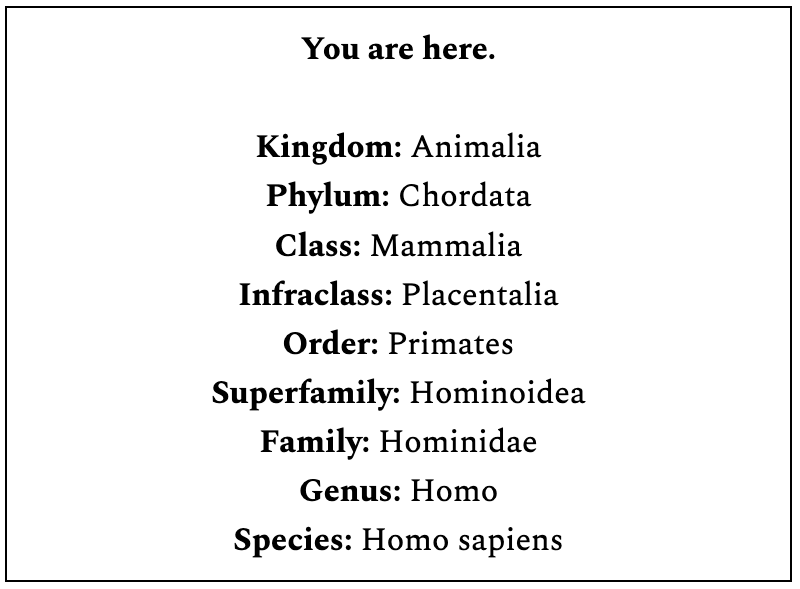
In a lot of ways, I’ve spent my life trying to locate myself on larger maps of relationships. Not just the traditional family tree (and mine is anything but traditional), but other forms of categorization, too. From what I can tell, this is a human trait; biologists aren’t the only ones interested in labeling and categories. We all do that. But sometimes, it gets problematic. Sometimes things don’t fit neatly into the categorization systems we’ve built.
Part of the categorization problem, at least for me, is that of race and culture and the way that personal genetic data points are interpreted in commercial ancestry testing. These services have rendered us with the false idea that we can map race and culture the same way we taxonomize species. We all want to belong somewhere, to have originated from somewhere, and if you’re anything like me, the structures of categorization that we have just don’t seem to fit right.
Attempting to categorize race and culture in a way that mirrors the branchings of a phylogenetic tree can give us a false projection of who we are. Genealogy is about familial relationships; taxonomies are about broad categories of types. But race and culture aren’t things that break off into smaller biological branches the way species do. In fact, these categories don’t belong in this particular schema at all. Race and culture are social and historical inventions, not biological data.
Relationships: Defining Family with Paper and Blood
I waited until I met my birthmother before I sent off the tubes of my saliva to Ancestry and 23&Me. It was a nerve wracking thing to do, but I wanted some validation on my brown skin, my black hair, and my deep love for queso. I was thirty-two years old and pretty deep into the deconstruction of my adoption. I’d already written a novel and a Master’s thesis on the subject. I’d already legally changed my name to reclaim the one I was given at birth and I’d already begun to interrogate my own definition of family.
A traditional definition of family can hardly account for the kind of network I’ve built for myself and my daughter over the years. I’m an adoptee and a divorced mother, so family trees, the traditional Ancestry types, get pretty weird for us pretty fast. My version of family accounts for adoptive and biological families, family members who refuse to be separated by a divorce, and the friends that have unapologetically burrowed permanently into our lives as chosen family.
There are, of course, exceptions to each of these categories. I’m not regularly in touch with some of my extended family members through the adoptive side, friendships have fallen away over the years, and I have only met my birthmother and her sister so there’s a great deal missing there, too. But I most often look to the relationships I’ve gained: an aunt who understands me, friends who cheer me on and support me, family members (adoptive and by marriage) who stuck around even when things were tough.
Until I began to deconstruct my adoption, the definition of family as I understood it was the kind that was linked by legal documents. First, in my adoptive family, bound by adoption decree, then in my husband’s family, bound by our marriage certificate and later broken (technically) by our divorce. The arrival of my first blood relative, my daughter, broke this chain and woke me up. When I finally began the search part of my adoptee journey, I started to wonder: if family isn’t legally bound, is it bound by blood? By oath? Is there only one way to be family or are there many ways? To be honest, I’m frustrated with the categorization systems I was born into. For a word so simple—family—the definition of it can be so complex, and for me, there’s an additional layer to the complexity. So far, I’ve outlined my family in terms of the relationships I have with different people within my adoptive family, my biological family, my ex-husband’s family, my chosen family. These are individual people I am in relationship with. But what about those broader strokes that, over enough time, can tie us to entire groups of people? What about the information we often find listed in our DNA results?
Culture: The Missing Context of Who I Am
The problem I have with trying to decipher my DNA results is that mine came up with a full third showing as Indigenous Mexico. It named possible people, not individual relatives, but tribes. Now, I can accept that my ancestry is obviously colored by the people who stayed in one place for long periods of time while also recognizing that all modern humans migrated out of Africa. I can also accept that when groups of us settled into a place, our features adjusted to the environments. That makes sense to the brain that grew up learning the intricacies of the animal kingdom and how evolution works. But I don’t feel right claiming a culture that I have been completely severed from. Culture is different from species. Species is a type of thing you are. Culture is something that’s often collective with shared rituals, space, and time. It’s inherited, remembered, or passed down through traditions. But what about those of us who have been severed from the people who would usually hand those things down?
Now you see my conundrum. I can know my species (unless I’m a space alien—still up for debate). I can form relationships with individual biological relatives as I’m able to find them (and that’s a whole other rant). But what can I know about the culture that lost me? Is this my personal genealogical history that I’m looking for, or is culture beyond that? Can culture even be contained in a type of taxonomy or a framework of organization? I guess what I’m asking is: is culture something I can connect back to? Can it be learned or recovered? Or is it something that I just have to accept the loss of? And either way the coin falls, how am I supposed to map myself into the larger picture when there are so many missing pieces in my family tree? The answer, for now at least, is that I’ve redefined what family is for me.
But the question of culture remains.
If there is any reconnecting or reclaiming to do, that falls to me. Because of the legal and social severance of adoption, I have no familial guides for how to navigate the ways in which I might wear this brown skin more proudly. However, I am reminded that culture is not just about ethnicity; culture encapsulates so many other facets of our identities. The adoption community is a group of people I am grateful to be among as I wrestle with these complexities. And isn’t my inclusion in this community a kind of culture, too? Perhaps yet another definition of family?
Future Maps of Identities
The real question is whether we can figure out a way to make the mapping of genealogical relationships, family structures, and cultural origins easier for people who have experienced severance. Much of my life has been spent trying to recover what has been lost, both intimate relationships and broader cultural origins. It makes sense, then, that I’d reach for the definition of human to feel as though I belong. But perhaps there are better ways to construct maps of identity that account for past rupture and include the room to build and reconnect. Maybe people like me just need permission to create their own frameworks rather than depend on ones that aren’t built to account for the complexities inherent in our situations.
I still think life as an adopted person is often colored by the way we conceptualize origins and engage in relationships. The problem with that is that many of the facets of adoptee life center on the ways we are othered or devalued by models of social invention. Would it be just as difficult to cope with a missing mother if we were sea turtles hatching without her on the beach? But we are not sea turtles; we are humans who exist in a complex web of social hierarchies that inform how we do or do not define family. That we know our genus and species is part of a scientific taxonomy process, but building a comprehensive map of our families is more complicated than assembling a pile of biological data or historical records. It’s not easy work, but we’re worth it. Our sea turtle mothers would agree.
Shannon Quist is the author of Rose’s Locket and Mirrors Made of Ink and is a TEDx speaker. She is currently pursuing a Ph.D. in Rhetoric at Texas Woman’s University and volunteers for Adoption Knowledge Affiliates. Her article, “Illuminated Ghosts and Phantom World Narratives” is forthcoming in Adoption & Culture. You can find more of her work at shannonquist.com and connect with her on IG @shannonrquist.